Unicollege 3As Academic Model: Acquire, Apply, Amplify
Unicollege structures its academic offer through the 3As Model: Acquire, Apply, Amplify, a coherent framework that integrates theoretical instruction, guided academic application, and field-based learning within a single course design.
Adopted across degree programs and international study abroad pathways, the model ensures academic consistency, transparency, and measurable learning outcomes, while promoting a form of education that connects disciplinary knowledge with real-world contexts.
The 3As Model reflects a precise academic principle: knowledge is first constructed, then applied, and ultimately expanded through direct engagement with reality.
Academic Design with Defined Outcomes
Each course at Unicollege is built through a deliberate academic architecture, where learning activities, contact hours, and assessment methods are aligned with clearly defined objectives.
Rather than separating theory and practice into distinct phases of education, the model integrates them into a single, progressive structure, ensuring that students move from foundational knowledge to autonomous analysis and contextual understanding.
This intentional design reflects a broader international approach to higher education, where academic rigor is reinforced by active learning methodologies and applied components, always under faculty supervision.
Acquire – Instructional Core
The Acquire phase represents approximately 70% of the course workload and constitutes the instructional foundation. Through lectures, seminar discussions, guided readings, and case-based analysis, students engage with disciplinary concepts, analytical frameworks, and methodological tools relevant to the subject area.
This phase is designed to establish academic grounding. Students develop conceptual clarity, disciplinary vocabulary, and structured reasoning skills aligned with university-level expectations. The instructional core remains fully documented through syllabi, defined learning outcomes, contact hours, and assessable components, supporting academic comparability and transfer review by partner institutions.
Apply – Capstone Project
The Apply phase accounts for approximately 20% of the course and centers on a guided Capstone Project. Under faculty supervision, students apply acquired knowledge to a defined research question, case study, or thematic inquiry connected to the course content.
This phase emphasizes structured problem-solving, critical analysis, and independent reasoning. Students produce assessable academic work—such as research papers, analytical essays, project reports, or presentations—that demonstrates their ability to synthesize theory and application within a disciplined framework.
Amplify – Field-Based Learning
The Amplify phase represents approximately 10% of the course and extends learning beyond the classroom. Through site visits, guest lectures, institutional engagement, or structured interaction with professional environments, students encounter the lived context of their field of study.
Field components are not experiential add-ons. They are academically framed, tied to course learning outcomes, and integrated into assessment through reflective analysis or applied deliverables. This phase enables students to connect theoretical knowledge with place-based observation, strengthening interpretive skills and contextual understanding.
From classroom to context
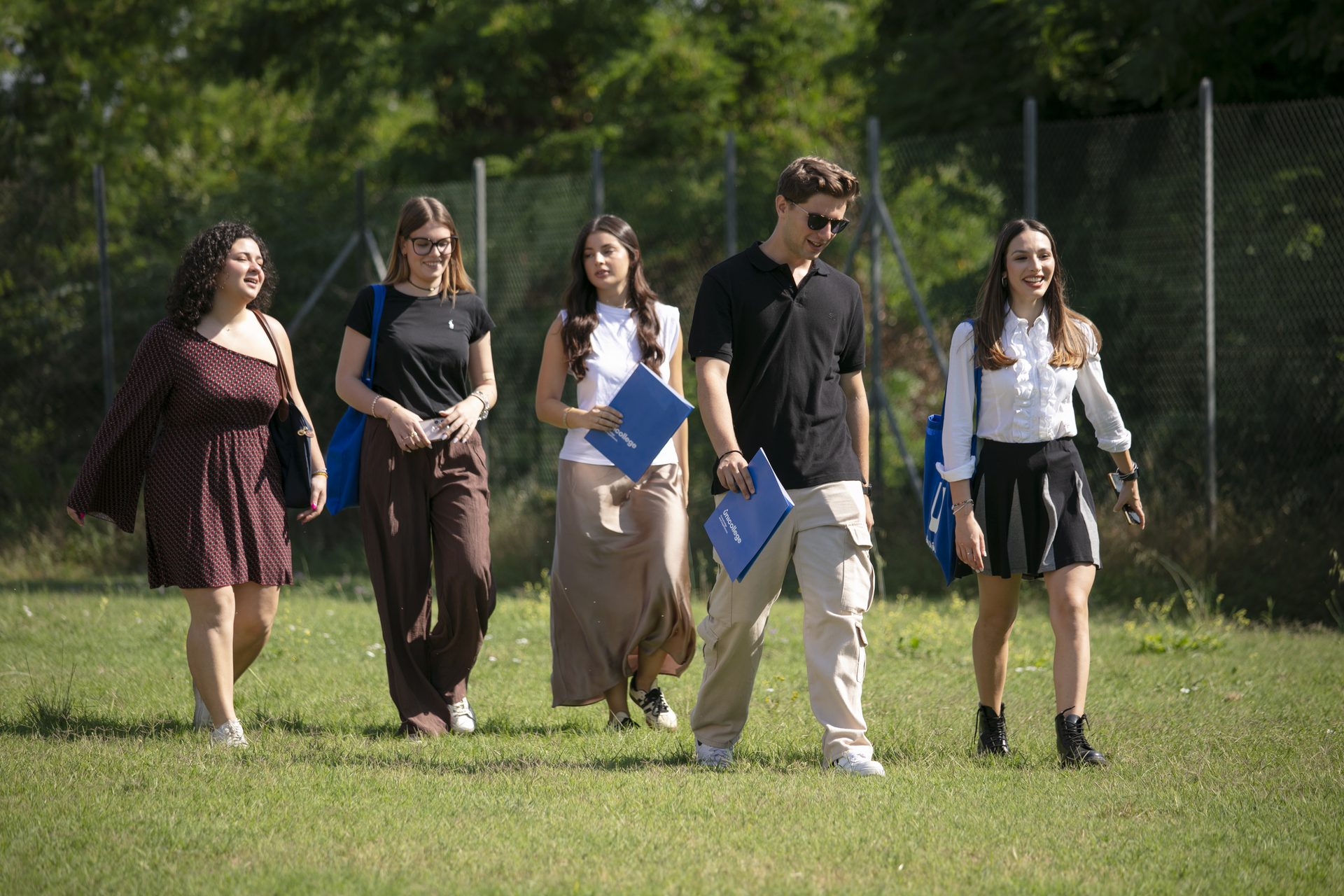
At Unicollege, learning is conceived as a continuous process that moves between classroom instruction and external environments.
Courses are designed to include moments of direct observation, interaction, and contextual analysis, allowing students to test and refine their understanding beyond theoretical frameworks.
This approach aligns with international academic models that emphasise the value of experiential learning, where knowledge is strengthened through exposure to professional practices, cultural environments, and contemporary issues.
Teaching as academic mentorship
A defining element of the Unicollege model is the active role of faculty throughout all phases of learning.
Professors do not only deliver lectures but:
- guide project development
- supervise analytical work
- contextualise field experiences within academic discourse
This continuous interaction ensures that experiential components remain academically grounded, transforming observation into structured knowledge and critical reflection.
The result is a model where teaching functions as mentorship within a rigorous academic framework.
Learning across fields and contexts
Unicollege encourages students to approach their studies through an interdisciplinary lens, connecting languages, communication, business, and cultural studies within a global perspective.
Courses are designed to highlight the interconnections between disciplines, reflecting the complexity of contemporary professional environments.
At the same time, the model incorporates an international dimension, allowing students to engage with different cultural and institutional contexts, both within Italy and abroad.
This dual focus prepares students to operate in environments where adaptability, cultural awareness, and analytical flexibility are essential.
Structured exploration
Within the 3As framework, students are offered opportunities to engage in academically structured experiences outside the classroom, including:
- thematic site visits
- institutional encounters
- short academic journeys and study-related activities
These experiences are designed not as isolated events, but as extensions of course content, contributing to the overall learning process and supporting the development of applied and reflective competences.
They reflect a broader educational approach in which mobility and exposure enhance academic understanding, while remaining integrated within a formal university structure.
Measurable and transparent learning
All components of the 3As Model are subject to defined evaluation criteria, ensuring that each phase contributes to measurable academic outcomes.
Assessment methods may include:
- written examinations
- project-based evaluation
- presentations and analytical reports
- reflective assignments linked to field experiences
This guarantees that experiential and applied elements are fully aligned with academic standards, maintaining the integrity and credibility of the university learning process.
Knowledge and experience within one academic system
By combining instructional depth, guided application, and contextual engagement, the Unicollege Academic Model offers a balanced and integrated approach to higher education.
The 70–20–10 structure provides clarity and coherence, while the inclusion of experiential and interdisciplinary elements allows students to engage with knowledge in a more dynamic and meaningful way.
In this model:
- knowledge is acquired with rigor
- competencies are developed through application
- understanding is expanded through experience
A university model for contemporary education
The Unicollege 3As Model represents a comprehensive vision of higher education, where academic rigor and experiential learning are not separate dimensions, but part of a unified design.
It prepares students not only to master disciplinary content, but to interpret, apply, and adapt knowledge within complex global contexts.