

Overview
Program Description
The Interpreting & Translation concentration forms part of the Bachelor's Degree with Student-Designed Pathways, allowing students to combine specialized study in interpreting and translation with advanced proficiency in two or three foreign languages selected from a portfolio of ten.
This integrated model reflects the increasingly multilingual nature of international organizations, institutions, businesses, media, and professional communication, where the ability to transfer meaning accurately across languages must be accompanied by a sophisticated understanding of culture, context, and audience.
The concentration examines how meaning is interpreted, transferred, and adapted across languages and cultures through an interdisciplinary curriculum combining translation studies, interpreting theory and practice, applied linguistics, discourse analysis, intercultural communication, and specialized translation. Students develop the linguistic, analytical, and communicative skills required to analyze complex texts and discourse, manage linguistic and cultural nuance, and communicate accurately across professional, institutional, and international environments.
The curriculum also explores emerging developments including audiovisual translation, localization, artificial intelligence, computer-assisted translation and interpreting technologies, multilingual digital communication, and the ethical challenges associated with linguistic mediation in an increasingly technology-driven profession.
By combining specialized expertise in interpreting and translation with advanced multilingual proficiency, students graduate with a distinctive academic profile suited to an increasingly interconnected world. Whether preparing for careers in translation, conference and institutional interpreting, localization, language services, international organizations, media, multinational companies, or postgraduate study, graduates develop the ability to interpret, translate, and mediate across languages, cultures, and professional environments — an increasingly essential competency in global communication.
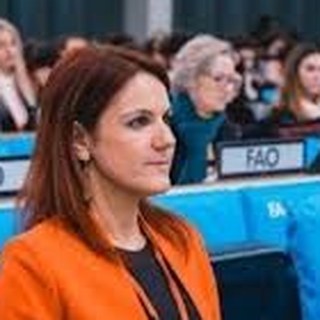
“Translation and interpreting teach us that language is never simply a matter of words; it carries culture, history, identity, and ways of seeing the world. Italy offers international students the rare opportunity to experience this complexity every day—to move between languages, contexts, and communities, and to understand communication not only as a skill, but as a form of cultural mediation.” - Prof. Federica Anna Oliveri, EdD c., Professor of Translation and Interpreting
Learning Model & Experience
All courses within the Interpreting & Translation program at Unicollege are structured according to the patented 3A (Acquire, Apply, Amplify) 70–20–10 academic model, which organizes learning into three progressive phases: instruction (70%), applied capstone work (20%), and field study (10%). This model is designed to ensure that theoretical knowledge, linguistic competence, and professional practice are systematically integrated throughout the academic pathway.
A representative example of this structure is the course Interpreting and Translation Practice, which explores the core techniques, strategies, and professional standards required for effective multilingual communication. During the Acquire phase, students are introduced to key concepts in translation and interpreting studies, including equivalence, register, discourse analysis, and interpreting modes (such as consecutive and simultaneous), through guided instruction and structured practice. The Apply phase consists of a mandatory capstone project in which students translate written texts and interpret spoken discourse across their working languages, engaging with authentic materials and addressing challenges related to context, audience, and accuracy. The course concludes with the Amplify phase, a field study conducted in collaboration with professional environments such as conference settings, language service providers, and media contexts, allowing students to observe and engage with real-world interpreting and translation practices.
Curriculum
Comparative Literatures and Contemporary Cultures6 ECTS / 3 US Credits
This course examines literary production and cultural expression from a comparative and contemporary perspective, exploring how texts, media, and cultural practices reflect and shape social, political, and historical realities. Students will analyze literary works, films, and cultural texts across different linguistic and cultural contexts, with particular attention to themes such as identity, migration, globalization, memory, and cultural exchange. Emphasis is placed on critical analysis, intercultural interpretation, and the relationship between literature and contemporary cultural debates. Through comparative analysis and critical writing, students will develop the ability to interpret cultural production within broader international and interdisciplinary frameworks.
Language, Communication, and Artificial Intelligence6 ECTS / 3 US Credits
This course explores the intersection between language, communication, and artificial intelligence, focusing on how emerging technologies are transforming linguistic practices, professional communication, and cultural production. Students will examine the role of AI in language processing, translation, content generation, discourse analysis, and digital communication environments. Emphasis is placed on the interaction between human and machine communication, ethical considerations, and the impact of artificial intelligence on professional sectors such as diplomacy, media, marketing, and legal communication. Through case studies, applied projects, and simulations, students will develop critical and practical skills to analyze, evaluate, and effectively use AI-driven communication tools in multilingual and multicultural contexts.
Internship6 ECTS / 3 US Credits
The Internship consists of a professional placement carried out at the national or international level in an institution, organization, or company selected according to the student’s curriculum concentration. The internship is designed to provide practical experience in professional environments related to forensics, fashion, humanities, diplomacy, or criminology, allowing students to apply the knowledge and skills acquired during their studies in real-world contexts. Through supervised professional activities, students will develop organizational, communication, and problem-solving skills, as well as a deeper understanding of workplace dynamics in international and multicultural settings. The internship represents an integral part of the academic program and contributes to the student’s professional development and career orientation.
Thesis6 ECTS / 3 US Credits
The Thesis represents the culminating academic experience of the Bachelor of Arts degree and is intended to synthesize the two main components of the program: the curriculum concentration and the language specialization. Students will conduct an academic investigation within their chosen concentration - forensics, fashion, humanities, diplomacy, or criminology - developing a structured research project that demonstrates originality, novelty, and academic maturity. The thesis is evaluated by two academic readers and must reflect the student’s ability to conduct independent research, engage with scholarly literature, and present a coherent analytical argument. In addition to the research chapters, students are required to produce sections of the thesis in the languages of their specialization. The program concludes with a final defense before an academic committee, which assesses the thesis for the conferral of the degree.
Careers and Post-Graduate Studies
The multidisciplinary structure of the Interpreting and Translation program enables graduates to operate in contexts where multilingual communication, linguistic mediation, intercultural exchange, and professional language services intersect, at both national and international levels.
Career paths
Graduates pursue roles across these areas at the national and international level.
- Translation and interpreting services
- Conference and diplomatic interpreting
- Specialized translation (legal, medical, technical, audiovisual)
- Localization and language technology services
- Media and audiovisual translation (subtitling, dubbing)
- Intercultural communication and consultancy
- Language project management and coordination
- Work with international organizations, language service providers, media organizations, public institutions, and private companies
Postgraduate studies
Continue with Master's degree programs in fields such as:
- Translation and Interpreting Studies
- Conference Interpreting
- Audiovisual Translation and Localization
- Applied Linguistics and Translation Technologies
- Intercultural Communication
- Language Studies and Linguistics
- Business Administration (MBA) or related management disciplines
The program provides the methodological preparation and academic foundation required for specialized professional training, advanced academic research, and careers in translation, interpreting, language services, and related linguistic and intercultural fields.
For applications or further information, please contact: admissions@unicollege.eu